Inked in Gray Press has acquired world English rights to The Raven at the End of Time by author Dave Walsh.
The Raven at the End of Time is a fabulist-inspired speculative fiction novel about a man coming to terms with his family legacy and his own sexuality.
On a hazy August afternoon, without warning, a nuclear bomb dropped in the middle of town.
Only it didn’t detonate. At least not immediately. Instead, the explosion slowed down, promising to explode over an excruciating 150 years. Officials deemed it not an immediate threat. In fact, it was so safe a park was built around it. Jacob’s familial connection with the bomb, and his twin brother Alex’s obsession over it, was enough to drive Jacob away, until the call came late one night: Alex had gone missing, and he was last seen tinkering with the bomb.
Unsure of who to trust, Jacob decides to track down his lost brother, cleaving his way through the tangled web of Alex’s life. In his way are a well-funded bomb cult, a connected politician, local business owners, anarchists, and a strange man in a tattered raven costume that can read his mind.
We had the opportunity to talk with Dave about his upcoming release to give readers a behind-the-scenes peek of The Raven at the End of Time!
What inspired you to write The Raven at the End of Time? Did any special or unusual circumstances or incidents play a role in the conception and/or writing of this book?
The initial spark came from raising my twin boys. They interact in such unique and impenetrable ways, which have only deepened and evolved as they grow older. Ravens pair off for life and remain inseparable, which is something I’ve played with a lot. I’ve lived in Albuquerque since 2006, and the city itself is so unique with such a rich history. The whole region is such a pastiche of beautiful landscapes, interesting people, and a strange history with the US nuclear program. Realizing there was a concentration here of people who immigrated from Germany during or after World War 2 led me to a lot of research, conversations, interviews, and, well, here we are.
I started writing this book in the summer of 2020, and I feel like that doesn’t require a lot of introduction where lots of us were stuck inside and watching while the western world’s seams finally started to tear apart in different, complicated ways. The idea of two brothers stuck in a whirlwind of their family’s past mistakes while dealing with very real issues through Jacob’s exploration of his identity appealed to me on such a foundational level. There’s a lot in here about living as a neurodivergent person in a hostile world, the ever-shifting gradients of our accepted sexuality, and the difference between external relationships and internal ones that drove me to write this book. I’ve spent years writing straightforward science fiction, which I enjoy, but I needed to push myself, and this book was born from that desire to always be moving forward.
Transdimensional nuclear bombs and makeshift ravens felt like the right vehicles for that somehow.
Without any spoilers, what was your favorite part of the book to write?
There’s a scene where Jacob is brought into a Lewis Carroll-inspired conspiracy led by a group of local business owners at the behest of the owner of a local knock off RadioShack store and there’s just an absurdity to all of these interactions that are layered with jokes and references.
Were there any major influences for you as a writer?
Absolutely. This book was very inspired by China Mieville’s The City and the City, along with Thomas Pynchon’s The Crying of Lot 49. The idea of the bomb as a central device that tears reality in different directions while people seem apathetic absolutely came from The City and the City. TCOL49 was the first book I read by Pynchon in college and helped broaden my perspectives of what “serious” fiction should be. As in, sort of absurd and funny instead of stuffy and pretentious. Tight, interwoven conspiracies, strange asides, and absurd characters lost in their own nonsense proved to be a driving force in my writing and what I aspired to create. I also can’t shake the work of Emily St. John Mendel, which toes multiple lines between genres and literary, absurd and realist, all while not being bound to any particular style or list of tropes.
Art as a whole, across different mediums, always bleeds through. My work wouldn’t be what it is without David Lynch or Andrei Tarkovsky (his bio, Sculpting in Time, is always on my desk for random inspiration). I listened to near endless amounts of Halsey, Prince, Chromatics, David Bowie, and Ember Knight while writing this book. I played through Mother 3 when writing this book, as well, and I can’t pretend that didn’t deeply move and influence me.
Without any spoilers, is there a character who holds a special place in your heart?
The Pilot. May we all have a pilot in our lives willing to call us on our bullshit, push us in the right direction, and remain objective when we start to lose sight of ourselves.
If your book had a soundtrack or theme song, what would it be?
I made a Spotify playlist for this ages ago here, but if it were a single album? Cheryl by Ember Knight. Ember had an Adult Swim show called, ahem, the Ember Knight Show, which at the time was just so unique, special, and hilarious. Cheryl is like absurdist Thin White Duke era David Bowie draped in a very modern, messy queer aesthetic and it’s amazing.
What is your favorite trope?
I have a very complicated relationship with this idea of literary tropes and how readers interface with them. Literature is such a personal experience, and I dislike the idea of being limited to ones I just enjoy or whatever. In theory, I shouldn’t adore Erin Morgenstern’s The Starless Sea or Night Circus, and yet they’re two of my absolute favorites, and are on my bookshelf next to a much more visceral, difficult, and strange books like Fernanda Melchor’s Hurricane Season and Roberto Bolaño’s 666. Our lives are all very short, and it’s worth pushing past our comfort zones. At least it is to me.
What was a memorable moment when you learned that language had power?
I’m sort of embarrassed that in my years I’ve never been able to find this book again, but the first time I found myself completely lost and engrossed in a book was when I was in second grade or so and was reading some awful Ninja Turtles book. It was about Donatello going into an alternate universe and having to find his way back home. I’ve never been able to find it again, but that’s my first memory of being fully immersed in a book to where when I was finished it felt like I had jet lag and was emerging from a different place. Ever since then I’ve chased that feeling to mixed results.
For something more grown up, I’m not sure I’ve ever been driven to vocalize my adoration of a book like I did reading the first hundred or so pages of Donna Tartt’s Goldfinch. Just immaculate.
So what are you reading now? What’s on your TBR List?
I just finished reading the heavily anticipated (at least to me) novella by Thomas Ha, Scion, which was in Clarkesworld issue 234, and have been working my way through both Ann Quin’s Berg and Vanessa Place’s La Medusa. At some point I need to sit down and read The Tunnel by William H. Gass, as it’s been staring at me from my shelf for a year now.
What other works have you published? Where can we find you?
I have two science fiction series out: the Trystero and Andlios series. They’re both space opera mixed with some cosmic horror. In addition, I have two standalone novels released as well: INTERGALACTIC BASTARD and Iconoclast; or, the Death and Resurrection of Lazarus Keaton. I’ve had short fiction published in Phano, Typebar Magazine, and Hell Itself, as well as a few other outlets. I’ve got a Patreon jam-packed with short fiction, as well, if that’s your kinda thing. You can find more about my books or stories at dvewlsh.com. I’m on Instagram as @dvewlsh, where I mostly post images of my dog, my hikes, and my little dudes. Where I’m most active is Bluesky as @dvewlsh.com, where I post about esoteric music and pro wrestling.
About Dave Wash
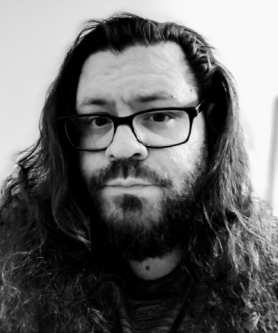
Dave Walsh resides in the high desert in New Mexico, a former combat sports and entertainment writer who focuses on the surreal instead now. Author of the Trystero and Andlios novels. Find him at dvewlsh.com and on BlueSky as @dvewlsh.com.
If you’d like to be notified when Raven at the End of Time becomes available for sale or as an ARC read, sign up for our newsletter below!